Córdoba and the Mezquita
12 min read
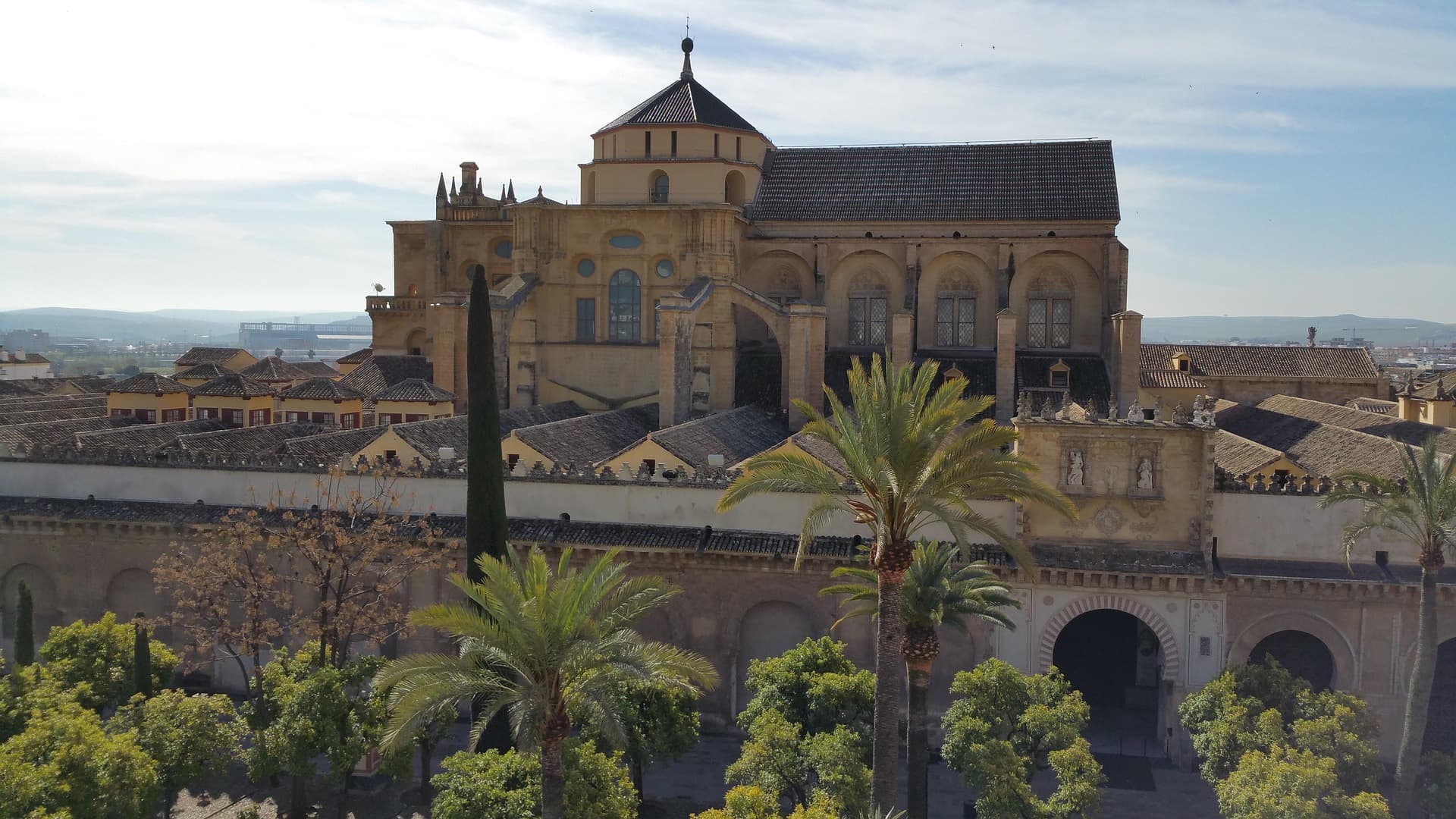
Córdoba is not a two-hour stop between Seville and Madrid. The train makes that fantasy easy: about forty-five to fifty minutes from Santa Justa, about an hour and forty-five from Atocha, and then a city that looks, on a tired afternoon, like a bridge, a bell tower, and a lunch. The building in the middle of that picture is the Mezquita-Catedral, a mosque hall with a cathedral planted in it, and it asks for the opening slot and a walk you cannot do if you are watching the clock for the onward AVE. Stay the night if you can. If you truly have only the day, spend the whole day. Spain 360 will happily put Córdoba between Seville and Granada. We will not pretend the Roman bridge is the visit.
How to actually see the hall
Book a timed ticket on the official site of the Mezquita-Catedral and confirm the current price there. Go at the first slot you can get. By eleven the columns are full of guided groups with flags, and the thing that makes this room different — repetition, dimness, the feeling that the grid continues farther than your eye — dies in the noise. Arrive a little early. The Patio de los Naranjos, the courtyard of orange trees in front of the hall, is the right place to stand before you go in. The bell tower was the minaret. A climb is often possible; confirm it that morning. Do the interior first, while it is still empty. The tower can wait until you know what you are looking down on.
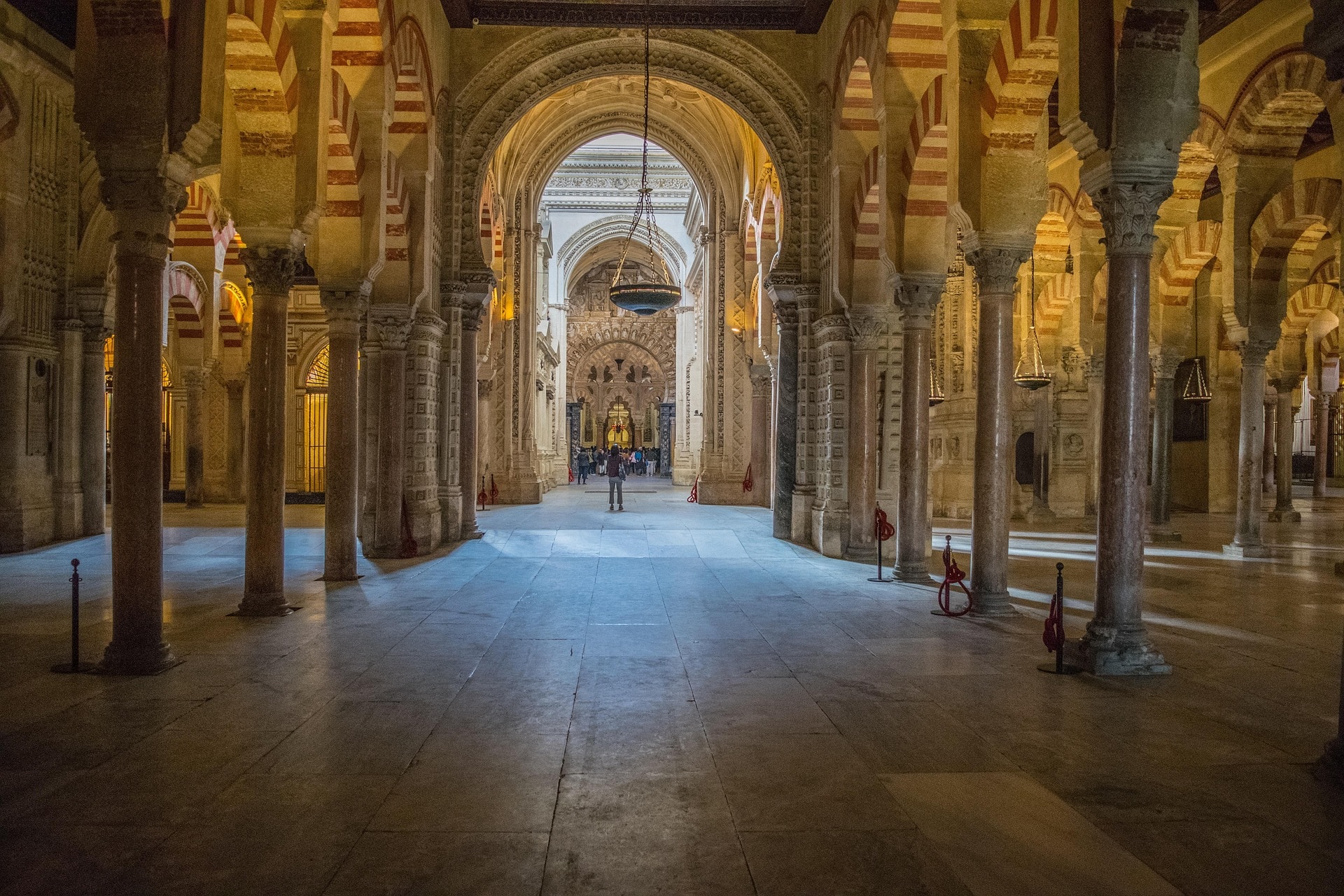
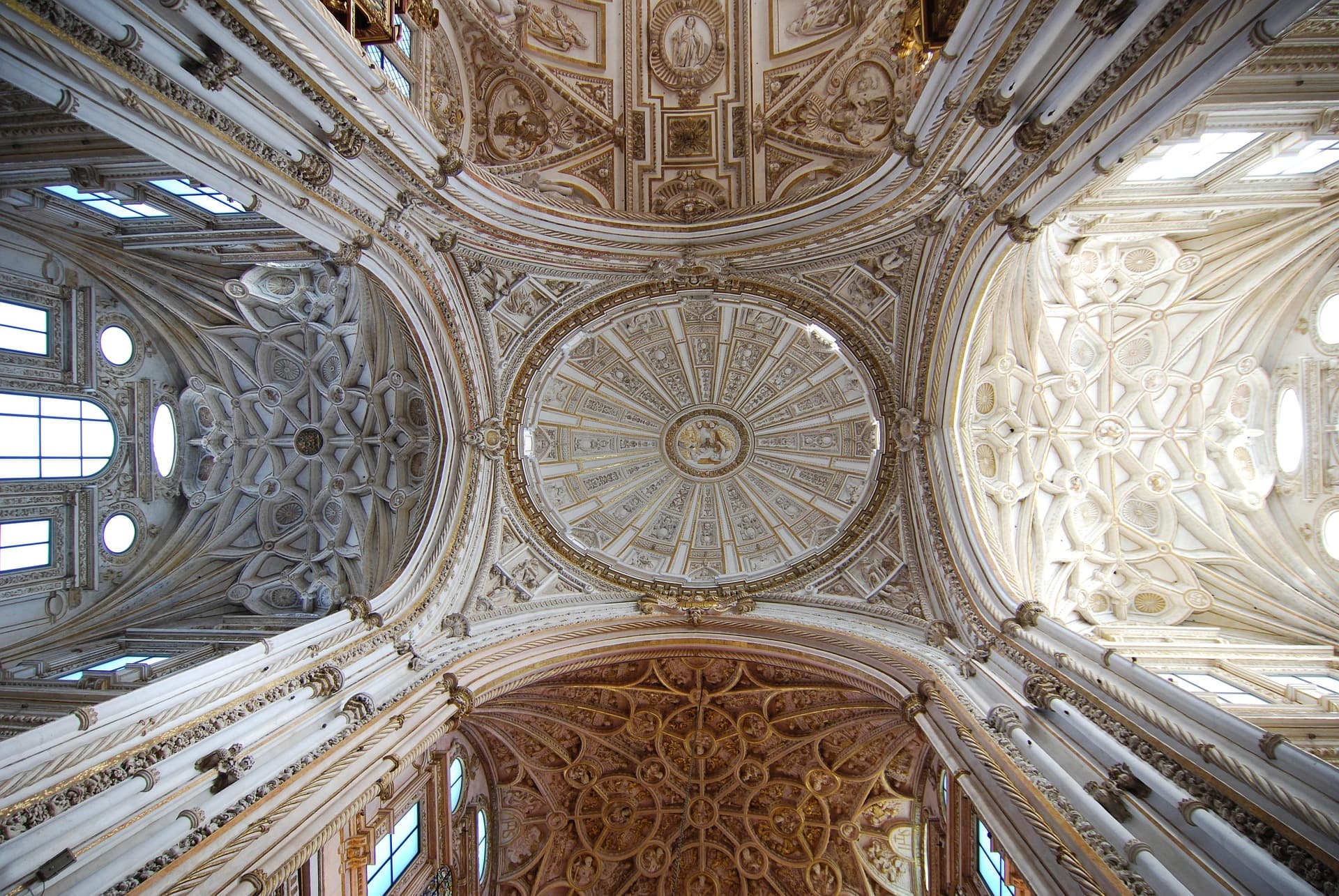
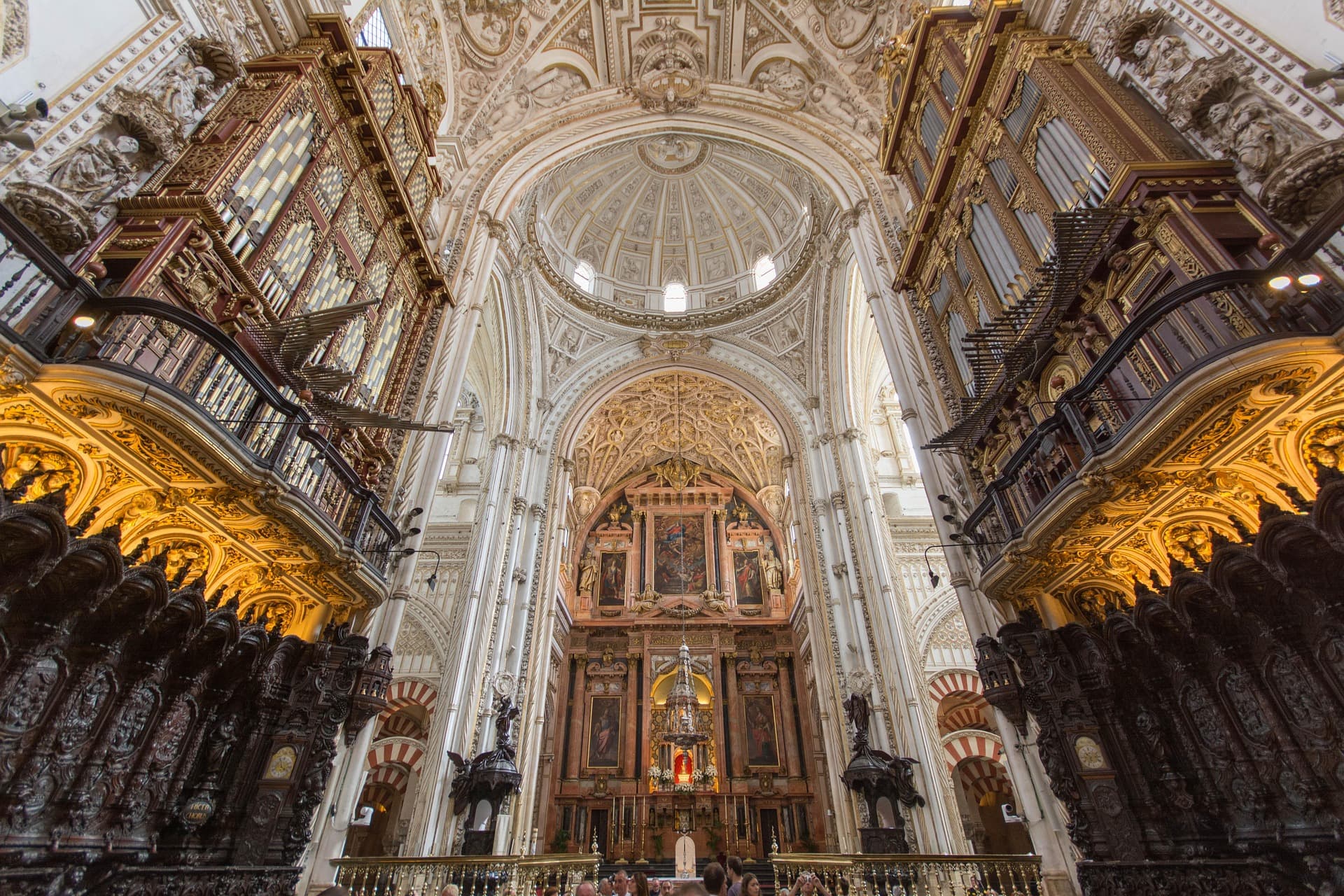
Inside, do not follow only the central nave. That bright axis is the 16th-century cathedral inserted into the middle of the 8th-to-10th-century mosque, and it is spectacular, and it is a trap. If you walk straight to the choir and the high altar, you will leave having seen a church. Turn off as soon as you can into the side of the hall. The columns are a forest of reused shafts, Roman and Visigothic pieces of different heights, which is why the builders stacked a second horseshoe arch on top of the first: red and white voussoirs, repeated until the engineering becomes a pattern. Look up. The double arch is the whole idea. Stand still long enough that your eyes stop hunting for a focal point. The hall’s focal point is the repetition.
Then work toward the mihrab, on the southeast wall, not in the bright center. The 10th-century chamber of Al-Hakam II is the richest part of the building: the lobed arch, the mosaics of the mihrab, the screened maqsura in front of it. This is what the forest was leading to. The Capilla de Villaviciosa and the royal chapel nearby show earlier Christian uses of the building, after Córdoba fell to Ferdinand III in 1236 and before the big cathedral was cut into the grid in the 1500s. Charles V is traditionally said to have regretted that insertion once he saw it. Treat the sentence as tradition. The evidence is in the join itself. Stand at the edge where the arches were cut and look up into the cathedral vault, then turn around and look back into the darker hall. That scar is the history. Photographing only the choir is how you go home with a cathedral and without Córdoba.
Give it sixty to ninety minutes if you are really looking, and leave before you are reading every chapel label out of duty. Twenty minutes, which is what a between-trains dash allows, is the central nave and the door. You will not have found the mihrab in any way that counts. Bags and shoulders: the hall is a religious building as well as a monument, and the rules on dress and silence are posted. Follow them. A timed ticket is not a license to treat the choir like a backdrop.
The Judería, the synagogue, and a museum you should check
The Judería is the lane-world west and north of the Mezquita. It is beautiful early and miserable at noon, when the Calleja de las Flores — a tiny alley of flowerpots with a framed view of the bell tower — becomes a queue to stand in a space three meters wide. Go there on the way out of the hall, not at sunset with every other person who read the same paragraph. The statue of Maimonides stands in the Plaza de Tiberiades, off Calle de los Judíos. He is not a mascot. Córdoba’s Jewish quarter is one of the places in Spain where the medieval community is still legible in the street plan, and it deserves a slower loop than a photograph of the statue’s foot, which people rub. You do not have to rub it.
The synagogue on Calle de los Judíos is small, 14th century, and one of the very few medieval synagogues left standing in the country. The visit is short. The stucco is the reason. Go in if it is open, even if you think you are “mosqued out.” It resets the scale: after the forest of the Mezquita, a single room does a different kind of work. Casa de Sefarad, nearby, is a small museum of Sephardic life in the quarter. Hours and even the operation have changed in the past. Check that it is open before you promise yourself the visit, and do not build the day around a closed door. The lanes still work if the museum does not. A closed Casa de Sefarad is a disappointment. A skipped mihrab is a wasted trip.
The Christian kings’ alcázar, which is really a garden
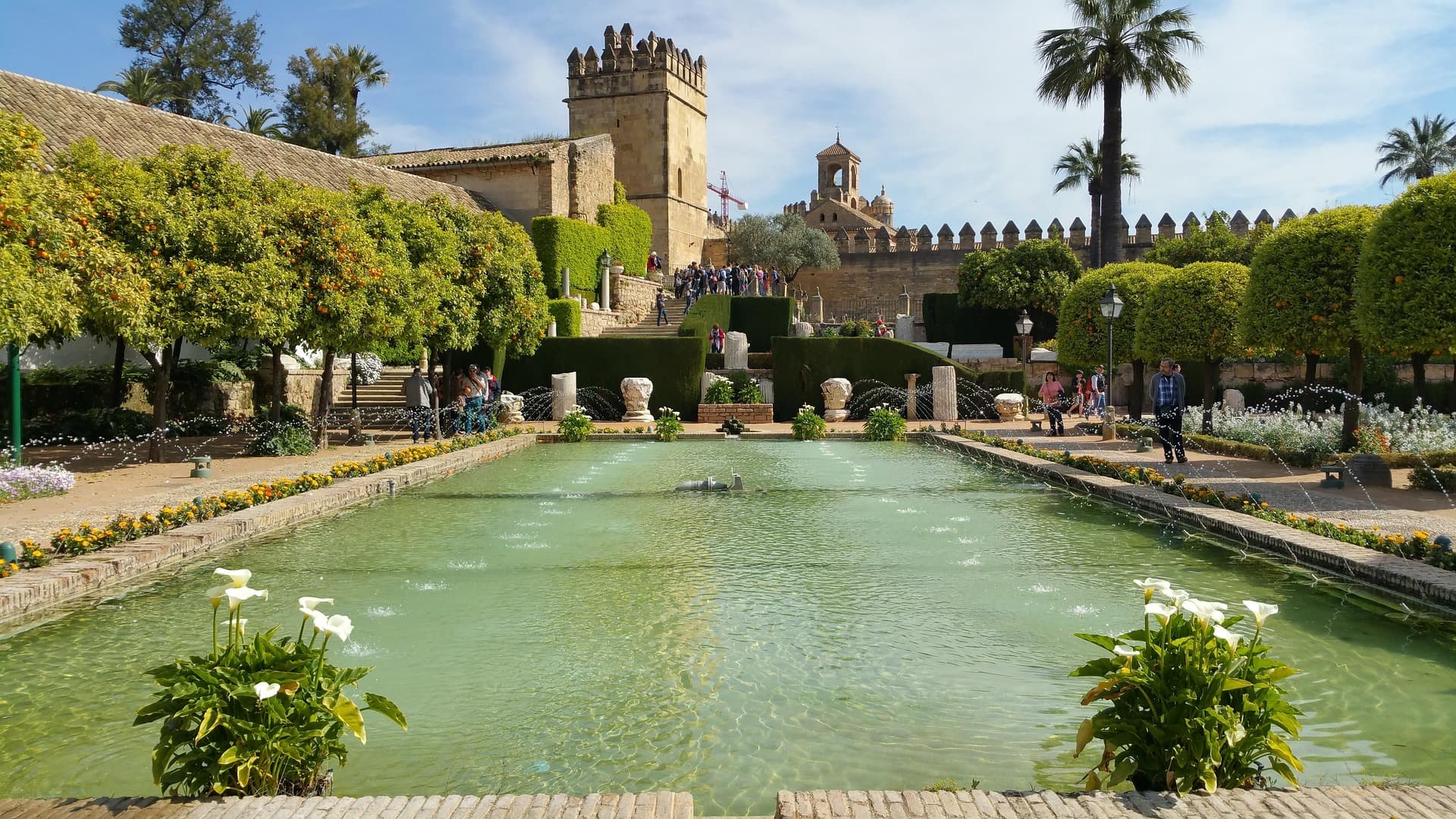
The Alcázar de los Reyes Cristianos is a short walk from the Mezquita along the river side. The fortress itself is modest, especially if you have already done the Alcázar in Seville, and that comparison is the reason people underrate it. The gardens are the visit: geometric pools, water channels, hedges, a quieter hour than Seville’s palaces ever give you in April. Give it an hour after lunch, when the Mezquita has done its work and you want to sit on a low wall and watch the water. The towers have views back over the river. They are a bonus, not a second Giralda you must climb out of guilt.
If you have an overnight, the Baños del Alcázar Califal, the caliphal baths near the alcázar, are the other indoor hour. They are a separate ticket. Confirm the price and whether you need a time on the official page. The baths explain the water you just saw in the gardens: this city was engineered around it, not sprinkled with fountains for your photograph. Skip them if you are running for the Seville train. Do not skip them if you woke up here with a free afternoon and you are tempted to “go to the outlet shops” instead. The shops will be there in every other city. The baths will not.
May, when the patios take the rooms
The Festival de los Patios usually occupies the first fortnight of May. Confirm the year’s dates, because a “Córdoba in May” hotel search that ignores the festival is how you end up on the highway. Private courtyards, especially in San Basilio and the Alcázar Viejo quarter and in other pockets of the old city, open to the public. The competition is real, the flowers are real, and the rooms vanish months ahead. If the patios are why you are coming, book the bed before you book the train, take the Mezquita at opening, and visit courtyards when that year’s program says they are unlocked. They are not open all day. A plan that says “we’ll wander into patios whenever” wanders into closed grilles.
If you hate crowds and you still want the idea of a Córdoba patio, come in late April or early June and go to the Palacio de Viana. It sits in the north of the old town, a walk or a short taxi from the Mezquita, and it holds a whole sequence of courtyards rather than a single festival winner. It needs more than a glance, on the order of an hour and a bit. It is the right substitute. It is not the festival, and you should not tell people you “did the patios” because you saw Viana on a quiet Wednesday. You saw Viana, which is a good sentence on its own. During the festival itself, Viana is still worth it and the Mezquita is more crowded. First slot, then the courtyards, and accept that the Calleja de las Flores will be impossible at noon. Let it be impossible. You already have the hall.
"Walk away from the bright nave. The mihrab is in the dark part of the hall, and the dark part is the point."— Spain 360 trip notes
The bridge is the photograph, not the visit
The Roman bridge and the Torre de la Calahorra, on the far bank, are what you do at the end of the day. Walk across, turn around, and look back: the bridge, the old gate, the mass of the Mezquita, the alcázar gardens to one side. The bridge has been rebuilt many times. You are not walking an untouched Roman original, and you do not need to. The view is the point. The tower holds a small museum about Al-Andalus. Go in if you like models and you have energy. Skip it if you are counting the minutes to a good dinner. People who spend their Mezquita hour on this bridge have their day backward. The hall does not improve at 5 p.m. the way the view does.
Sleep in the old center or just across that bridge. The Judería, the streets toward San Francisco, the area around Plaza de las Tendillas if you want a slightly more ordinary Córdoba: all of these keep you inside a fifteen-minute walk of the hall. Campo de la Verdad, on the Calahorra side, works if you are happy to cross the bridge in the evening, which is a pleasure and not a hike. A hotel on the highway, or out by the airport because the rate looked clever, is how a small city becomes a taxi problem. Córdoba does not need a resort. It needs a door you can open onto a street that leads to the orange courtyard.
Salmorejo, flamenquín, and the square to aim for
Salmorejo was born here. It is not gazpacho. Gazpacho is a thinner cold soup. Salmorejo is tomato, bread, garlic, and olive oil, blended until it is almost a puree, served cold, finished with chopped egg and jamón. Eat it at lunch, as a first plate, in a room that is not the first terrace under the bell tower. The second plate, if you want the local canon, is flamenquín: pork loin rolled around ham, breaded, fried, and sliced so you can see the spiral. It is heavy. It is a lunch food. Rabo de toro, oxtail stewed until it gives up, is the other one, rich and brown and not a thing you order because you are about to walk 12,000 steps to a train with your suitcase. Berenjenas con miel — fried eggplant with honey — will appear whether you ask or not. Have a few if you are sharing. Do not let them become the whole meal in a city that invented a better tomato.
Plaza de la Corredera is the square we would point you toward when the Judería feels like a stage. It is a big rectangular plaza, a little worn, with bars that are serving lunch to people who are not on a monument schedule. Tendillas is the other pole, busier, more the modern center. Sit down around 2 and stay until 4 if the train allows. Dinner, if you are sleeping here, starts in earnest after 9. A 6:30 table by the Mezquita is how you eat a worse meal and still miss the bridge in the good light. Have a drink, walk the far bank, and come back when the city is eating.
A day from Seville, and a better overnight
The day-trip version, if it is all you have, starts early at Santa Justa in Seville. The ride is about forty-five to fifty minutes on the Avant or AVE corridor. Confirm that day’s schedule, because “about fifty minutes” is not a promise that the 8:10 is running on the Saturday you picked. Córdoba’s station is west of the old center. A taxi is the right move when you are protecting an opening slot. The walk is on the order of twenty-five minutes and it is a nice walk when you are not late and not wheeling a bag. Be at the hall for the first entry. Give it the full hour and a half. Calleja de las Flores and the synagogue while the lanes are still possible. Lunch — salmorejo, then flamenquín — toward Corredera, not under the tower. Alcázar gardens after. The bridge last. A late-afternoon train back to Seville. You did not see Medina Azahara, you did not see Viana, and you are not behind. You spent the day in Córdoba. That is the success. The failure is the version where you arrive at 1, photograph the nave, stand on the bridge, and make the 4 o’clock back, then tell people the Mezquita was “fine.”
The overnight is the one we would sell you if the tickets are in our hands. Arrive late morning from Seville or on the AVE from Madrid, about an hour and forty-five from Atocha, again confirming the train. Mezquita at opening if you can still get it, or the earliest slot that remains. Long lunch. Gardens. Bridge at dusk. Sleep in the radius already described. The next morning belongs to Medina Azahara, not to a second lap of the same three lanes. If your onward train is to Granada, remember that link is the awkward one: by road a little over two hours, by train a connection you must confirm. Do not put Medina Azahara and a vague Granada arrival and an Alhambra slot on the same day. The palaces will not care that the ruins were interesting.
Medina Azahara, the second morning
Medina Azahara, Madinat al-Zahra, is the palace-city Abd al-Rahman III built west of Córdoba in the 10th century and which was wrecked in the 11th. It is not a casual stroll from the Mezquita. It is a taxi or the official shuttle, on the order of fifteen minutes once you are actually moving, and then a site with its own museum. Check the official page for a timed ticket, the shuttle schedule, and the current price. Go in the morning. Do the museum first so the terraces mean something, then walk the excavated palaces and the partial reconstruction. The city of Córdoba sits in the view on purpose. The caliph was looking at it. You should too.
The terraces are exposed. In July the middle of the day is a punishment, the same punishment as a noon Alcázar in Seville, with less shade. A second morning in October is one of the better archaeological walks in Spain. A second morning you try to fold in “on the way to the airport” is a glimpse of a car park. Give it the half day. Then go back into town for a last salmorejo or for the train. If you only have one morning in Córdoba in your whole life, spend it in the Mezquita, not at Medina Azahara. The ruins deepen the hall. They do not replace it. If you have the second morning, the ruins are no longer optional in any trip we are proud of.
Seville–Córdoba is about 45–50 minutes; Madrid–Córdoba about 1 hour 45. Confirm the day’s Avant or AVE. Confirm Mezquita and Medina Azahara prices on the official sites.
| The time you have | Spend it on | You will not also |
|---|---|---|
| A day trip from Seville | Opening Mezquita, synagogue, lunch, alcázar gardens, bridge, train back | Medina Azahara, Viana, and a Granada sunset |
| One night | Hall, long lunch, gardens, bridge at dusk, sleep in the old center or across the river | A highway hotel and a 7 a.m. dash that still misses the mihrab |
| A second morning | Medina Azahara by taxi or shuttle, museum first, terraces before the heat | A stroll from the Patio de los Naranjos. It is not walkable as an errand. |
| The first half of May | A room booked months ahead, Mezquita at opening, patios when the program unlocks them | Wandering into closed courtyards at noon and calling it the festival |
| Forty minutes between trains | Stay on the train. Córdoba will still be here. | A meaningful visit. The hall does not compress. |
- Timed ticket, official site, first slot. Ninety minutes if you are actually looking.
- Synagogue on Calle de los Judíos is small and worth it. Casa de Sefarad: check the door.
- Alcázar gardens beat the fortress rooms. The caliphal baths are the overnight extra.
- Salmorejo, flamenquín, rabo de toro. Not the first menu under the bell tower.
- Sleep within a fifteen-minute walk, or just across the bridge in Campo de la Verdad.
- Medina Azahara is the second morning, by taxi or shuttle, or it is a rumor.
Córdoba is a small city with one building that contains two religions and a very clear way to miss the point. Open the door early, walk into the darker rows, find the mihrab, and only then look up into the cathedral that was dropped on top of it. Eat salmorejo where you can sit down. Cross the bridge when the stone is warm. If you are still here tomorrow, go west to the palace-city and see what the caliph was looking at. That is a visit. The rest is a change of trains.
Plan Your Spain Trip
Talk with our Spain-based team about small-group departures, private itineraries, and straightforward travel from the US—we handle the details.
Contact UsRecommended Journey
Classic Andalusia
A private week that reaches Córdoba with a night to spare: Seville, the white villages, Ronda, Granada’s Alhambra, and a real morning in the Mezquita rather than a bridge photo between trains.
View the itineraryExpert's Tip
Be at the Mezquita when it opens and walk the outer rows of columns before you walk the cathedral nave. The mihrab is in the southeast of the hall, not in the bright middle.
Get the Soul of Spain in Your Inbox
Join our curated list for exclusive travel stories, hidden jazz venues, and expert guides delivered once a month.